
The Enneagram: What’s My Type?
Your personality shapes how you move through the world—including how you eat, respond to stress, approach change, and care for yourself.
The Enneagram can help you understand the deeper motivations behind those patterns. Once you begin to recognize them, you have more choice about how you respond rather than simply repeating what comes automatically.
The first step is figuring out your Enneagram type.
How To Determine Your Enneagram Type
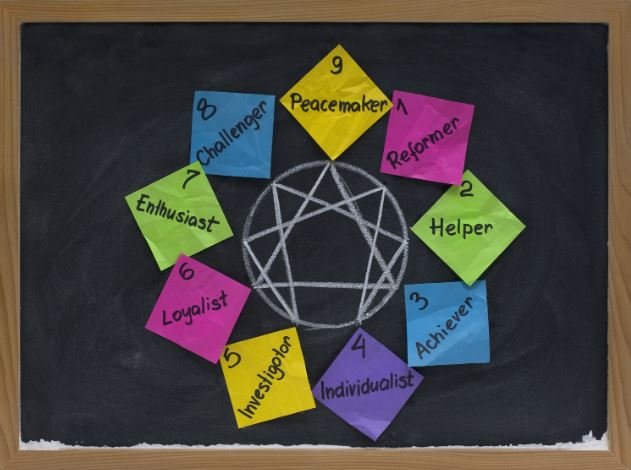
There are nine Enneagram "types." Each type has the same basic motivations and views the world in similar ways. As you learn about your type you will learn more about your gifts and positive qualities. You will also learn more about your self-defeating tendencies, blind spots, and ways to get yourself stuck.
It is often difficult to face ourselves with the level of honesty the Enneagram provides. Know that there is no one pattern that is better than any other. Each has fascinating positives, and equally fascinating negatives associated with it.
Enneagram tests are interesting and can lead you in the right direction, but they can give inaccurate results, primarily because the Enneagram so expertly reveals our shadow side, and most of us do not know our shadow side well.
When I first identified my type, I found my type, but then discounted much of what I read: “Except that is not me. Neither is that. Or that.” Then, weeks later, I would be doing something and realize, “Oh my goodness, that is exactly what the book described, and I AM doing it!”
The descriptions below are brief snapshots, not complete portraits. Each Enneagram type can show up in many different ways depending on the person, their life experience, and how they have developed over time. What matters most is not whether every trait fits, but whether you recognize the deeper motivations and patterns underneath them.
Enneagram Type Descriptions
Type 1: The Reformer
Perfectionists, responsible, fixated on improvement
Ones are essentially looking to make things better, as they think nothing is ever quite good enough. Their minds are constantly scanning for what is wrong, with themselves, those around them, and the world. This makes them perfectionists who want to reform and improve, who desire to make order out of the omnipresent chaos.
Type 2: The Helper
Helpers who need to be needed
Twos essentially feel that they are worthy insofar as they are helpful to others. Love is their highest ideal. Selflessness is their duty. Giving to others is their reason for being. Involved, socially aware, usually extroverted, Twos are the type of people who remember everyone's birthday and who go the extra mile to help out a co-worker, spouse or friend in need.
Type 3: The Achiever
Focused on the presentation of success, to attain validation
Threes need to be validated in order to feel worthy; they pursue success and want to be admired. They are frequently hard working, competitive and are highly focused in the pursuit of their goals, whether their goal is to be the most successful salesperson in the company, be the best dancer, or the "sexiest" guy in their social circle.
Type 4: The Individualist
Identity seekers, who feel unique and different
Fours build their identities around their perception of themselves as being somehow different or unique; they are thus self-consciously individualistic. They tend to see their difference from others as being both a gift and a curse - a gift, because it sets them apart from those they perceive as being somehow "common," and a curse, as it so often seems to separate them from the simpler forms of happiness that others so readily seem to enjoy.
Type 5: The Investigator
Thinkers who tend to withdraw and observe
Fives essentially fear that they don't have enough inner strength to face life, so they tend to withdraw, to retreat into the safety and security of the mind where they can mentally prepare for their emergence into the world. Fives feel comfortable and at home in the realm of thought. They are generally intelligent, well read and thoughtful and they frequently become experts in the areas that capture their interest.
Type 6: The Loyalist
Conflicted between trust and distrust
Sixes essentially feel insecure, as though there is nothing quite steady enough to hold onto. At the core of the type Six personality is a kind of fear or anxiety. Sixes don't trust easily; they are often ambivalent about others, until the person has absolutely proven herself, at which point they are likely to respond with steadfast loyalty.
Type 7 - The Enthusiast
Pleasure seekers and planners, in search of distraction
Sevens are essentially concerned that their lives be an exciting adventure. They are future oriented, restless people who are generally convinced that something better is just around the corner. They are quick thinkers who have a great deal of energy and who make lots of plans. They tend to be extroverted, multi-talented, creative and open minded.
Type 8 - The Challenger
Taking charge, because they don't want to be controlled
Eights are essentially unwilling to be controlled, either by others or by their circumstances; they fully intend to be masters of their fate. Eights are strong willed, decisive, practical, tough minded and energetic. They also tend to be domineering; their unwillingness to be controlled by others frequently manifests in the need to control others instead.
Type 9 - The Peacemaker
Keeping peace and harmony
Nines essentially feel a need for peace and harmony. They tend to avoid conflict at all costs, whether it be internal or interpersonal. As the potential for conflict in life is virtually ubiquitous, the Nine's desire to avoid it generally results in some degree of withdrawal from life, and many Nines are, in fact, introverted. Other Nines lead more active, social lives, but nevertheless remain to some to degree "checked out," or not fully involved, as if to insulate themselves from threats to their peace of mind.
Getting Clarity on Your Enneagram Type
You will find many different Enneagram tests on the internet. They are notoriously inaccurate, simply because they are attempting to reveal what is not conscious to you. Because you are not familiar with these deeper underlying motivations, you may test in a way that is not accurate. I recommend you use the tests as a tool. Pick the top 3 or 4 choices and read about those types. See which you most resonate with.
My favorite test is in the book Wisdom of the Enneagram. After that is the test at the Enneagram Institute website. Links below.
Enneagram Resources
If you’d like to explore the Enneagram more deeply, these are some of the resources I’ve found most useful over the years.
The Wisdom of the Enneagram — a great place to start. Don’t miss the later sections on using the Enneagram for personal and spiritual growth.
The Enneagram Made Easy — an accessible and fun introduction, with cartoons and simple explanations that make the nine types easy to grasp.
The Enneagram in Love and Work — a good introduction to each type, with an especially useful look at how the different types interact in work and close relationships.
The Spiritual Dimension of the Enneagram: Nine Faces of the Soul — a deeper exploration of the Enneagram and spiritual growth, best read once you already have a basic understanding of the system.
For type descriptions, testing, and additional Enneagram information, visit the Enneagram Institute.
The Enneagram School of Awakening is where I received most of my Enneagram training. The school teaches the Embodiment Tradition developed by Dr. Lissa Friedman and offers courses, workshops, and professional training.
What Does Your Type Have to Do With Eating?
Once you have a sense of your Enneagram type, the next question is what those patterns might have to do with food and eating.
Read How the Enneagram Can Help You Understand Your Eating Patterns.



Learn how each Enneagram type experiences holiday triggers, stress, and eating patterns. Looks at navigating food, family, and seasonal pressures without diet culture.